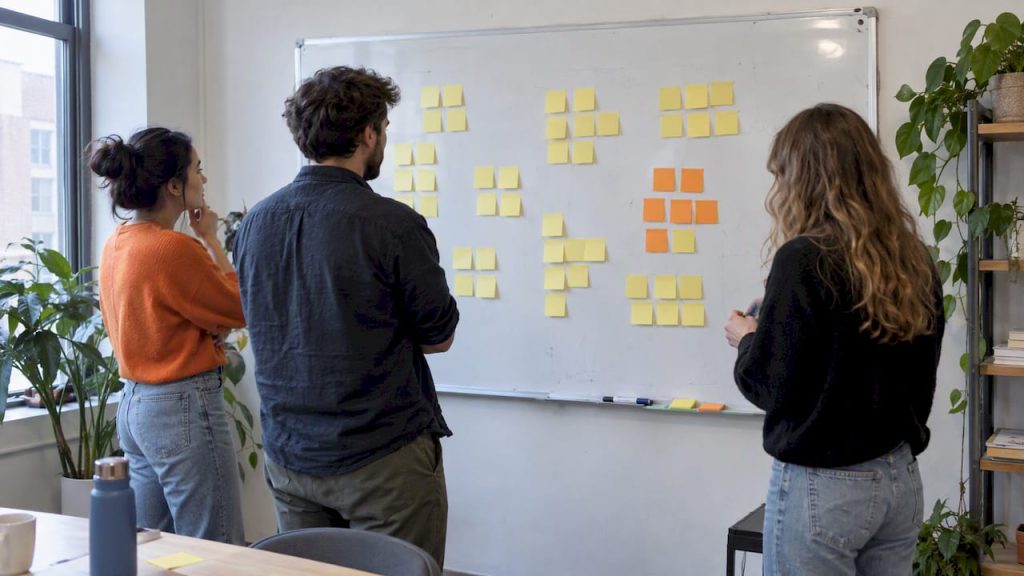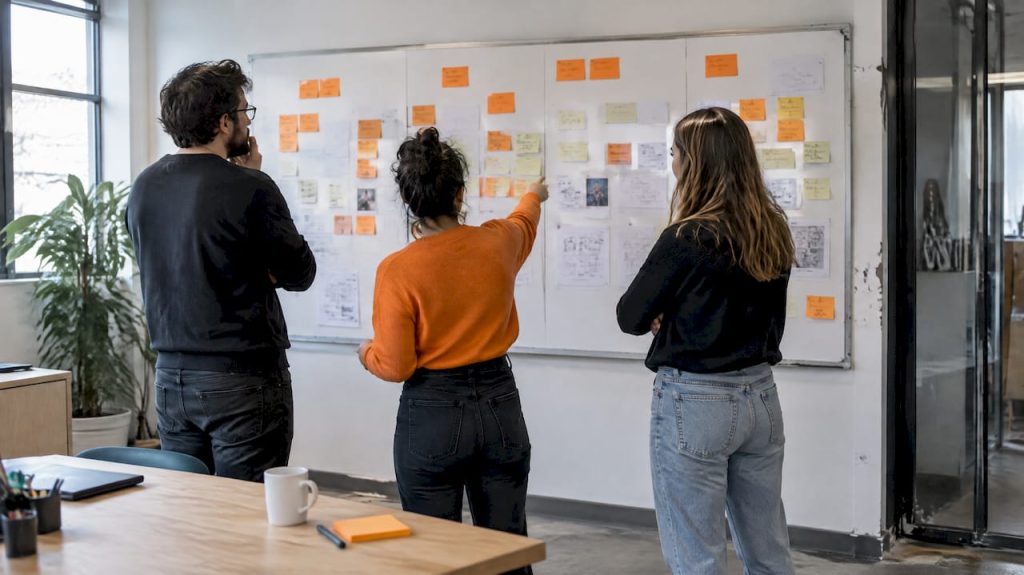
Brainwriting online means that everyone on your team or in your class writes ideas on a shared digital canvas, silently and at the same time, before anyone debates them. It works because no one waits for a turn to speak, no one talks over anyone else, and the quietest person’s best idea sits on the board next to the loudest person’s first one. Below you will find the method, a board layout you can copy in a few minutes, worked examples, and the mistakes that sink most sessions.
TL;DR
- Brainwriting swaps talking for writing: each person generates ideas on their own, then reads and builds on the others’ ideas.
- The classic 6-3-5 format uses six people, three ideas each, in five-minute rounds, for up to 108 ideas in 30 minutes.
- Research on student groups found no significant productivity gap between paper and digital brainwriting, so a browser board is enough.
- Keep a short, spoken discussion after the silent rounds. Pure silence is not the goal.
Table of Contents
- What brainwriting is, and why teams use it
- Brainwriting vs. brainstorming
- The 6-3-5 method, adapted for a browser
- Set up your board in minutes
- Brainwriting examples you can borrow
- Does digital work as well as paper?
- Make it inclusive, not just silent
- Our perspective: simple beats feature-rich
- Run your next session on a board that opens instantly
- Common mistakes and how to avoid them
- Other virtual idea generation techniques to pair with it
- FAQ
- Sources
What brainwriting is, and why teams use it
Brainwriting is a structured idea generation technique. Each participant writes responses to a single question, then passes their ideas to a neighbor, who reads them and adds new ones. The writing replaces the talking, and the structure replaces the free-for-all.
The reason to bother is group dynamics. Peter Heslin’s paper on boundary conditions for brainwriting points out that brainstorming is popular but often less productive than people expect, because of dominant voices and production blocking, which is what happens when you hold an idea in your head while someone else is speaking. A time-boxed, sequenced written format reduces both problems, and it tends to help larger groups and more introverted participants most.
There is a status effect too. Facilitators quoted in Forbes describe how brainwriting reduces ego threat and conformity pressure, so a junior teammate’s idea is judged on its merits rather than on who suggested it. For a remote team spread across time zones and seniority levels, that matters.
Brainwriting vs. brainstorming
The two are not enemies. Brainstorming is good for alignment and energy. Brainwriting is good for volume and fairness. Here is how they compare in practice.
| Criterion | Verbal brainstorming | Brainwriting |
|---|---|---|
| Who contributes | Mostly the fastest speakers | Everyone, at once |
| Production blocking | High: you wait for your turn | Low: everyone writes in parallel |
| Influence of seniority | Strong | Weaker, especially if ideas are anonymous |
| Energy and banter | High | Quieter |
| Record of ideas | Someone has to capture it | Built in, on the board |
| Best for | Aligning, clarifying, building on a few ideas | Generating many ideas, sensitive topics, large groups |
The NN/G guidance on diverge-and-converge workshops makes a related point: asynchronous work is valuable but does not fully replace live meetings, because teams still need a moment to align on language, resolve nuances and clarify intent. The strongest approach is a blend: write first, talk second.
The 6-3-5 method, adapted for a browser
The best known version was developed in 1968. Six people each write three ideas in five minutes, then pass the sheet along. After six rounds, you have 108 possible ideas (6 people x 3 ideas x 6 rounds) in about 30 minutes.
Online, the “sheet” becomes a row or a frame on a shared canvas. Instead of physically passing paper, participants move to the next row when the timer ends. Here is the full routine.
- Write one clear prompt. Phrase it as a question that can have many answers: “How might we cut onboarding time for new customers?” beats “Onboarding.” Put it at the top of the board.
- Create one frame per participant. Each frame has three empty sticky notes in the first column and room to grow to the right. Label frames with names, or with numbers if you want anonymity.
- Round one: write. Set a five-minute timer. Everyone writes three ideas in their own frame. Short phrases, not essays.
- Rotate. When the timer ends, each person moves to the next person’s frame. Tell people the direction aloud so no one lands on a frame that is already occupied.
- Read, then build. In the next round, participants read the earlier ideas and add three new ones. A new idea can extend, combine or twist what is already there, but it should not repeat it.
- Repeat until you have gone around. With six people that is six rounds. With smaller groups, shorten the cycle: four people and four rounds still produce a big pile.
- Cluster and vote. Drag similar notes into groups, name each group, then let everyone place a limited number of votes.
- Discuss the top clusters aloud. This is where the spoken conversation earns its place.
You do not need exactly six people. If you have ten, run two parallel boards of five. If you have three, give each person two or three rounds and a longer timer.
Set up your board in minutes
A good brainwriting board is boring on purpose. Complexity slows people down.
- Top-left: the prompt, in large text, and the rules (“three ideas per round, five minutes, build on what you read”).
- Center: one horizontal lane per participant, each with three starter sticky notes.
- Right side: an empty “parking lot” zone for clustering after the rounds.
- Bottom: a voting area, with a note on how many votes each person gets.
A browser-based canvas with infinite zoom helps here. You can zoom out to see all lanes during clustering, then zoom in to a single lane when you want to read it carefully. If you want to compare what is on offer in this category, our guide to online whiteboard tools for teams lists the features that matter for a session like this.
Brainwriting examples you can borrow
Three prompts, three contexts, each with a realistic way to run it.
A product team prioritizing a roadmap
Prompt: “What would make our new users reach their first success in under ten minutes?” A group of six product managers, designers and engineers runs the full 6-3-5. After clustering, themes tend to emerge, such as setup friction, unclear empty states and missing templates. Each theme becomes a candidate for a ticket. If your team also runs structured planning sprints, the remote design sprint board examples show where brainwriting fits in the divergent phase.
An agile retrospective
Prompt: “What slowed us down this sprint, and what could we try next?” Retros are a natural fit for anonymous brainwriting, since people are more candid when notes are not attributed. Use two rounds instead of six, then group the notes by theme. Our retro board ideas give you layouts to pair with it.
A classroom or tutoring session
Prompt: “What are the causes of the French Revolution?” or, for a writing class, “Where could this story go next?” Students write silently, rotate, and add to a classmate’s list. Students who hesitate to speak in front of a class have a way in. A shorter timer (three minutes) suits younger learners. For more formats, see our collection of digital classroom brainstorm activities, and for one-to-one work the virtual tutoring session checklist.
Does digital work as well as paper?
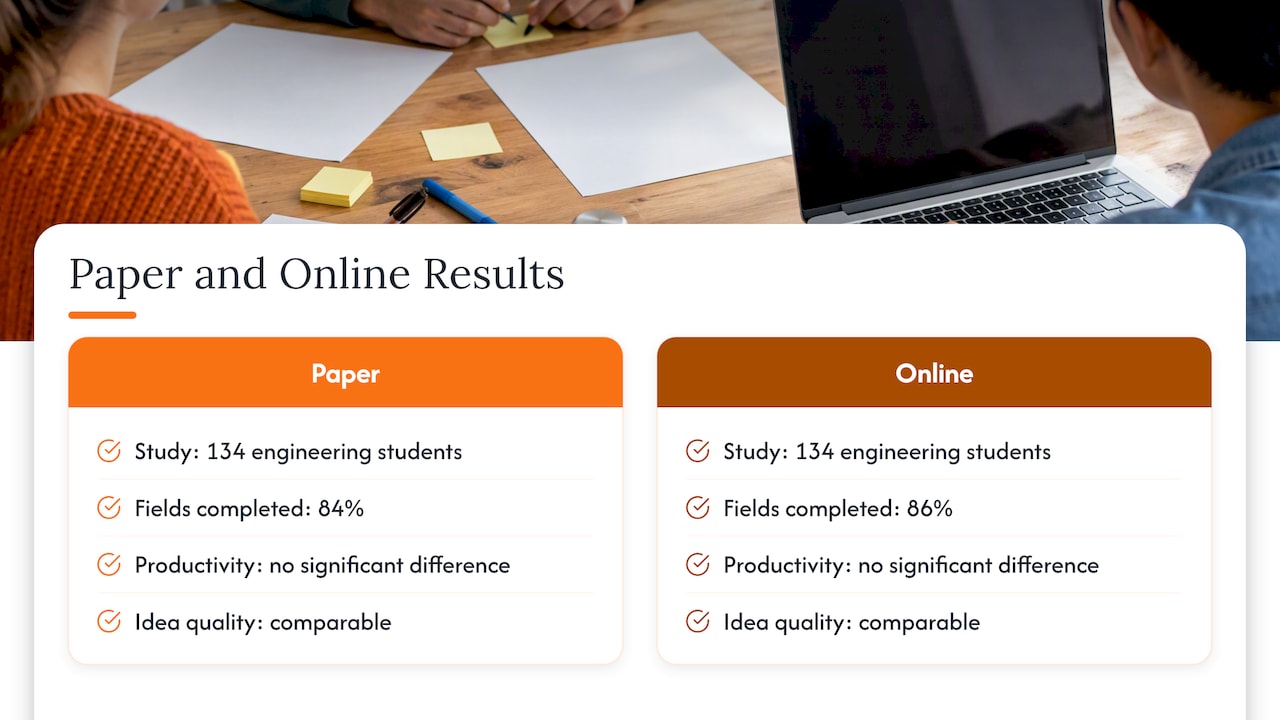
A common worry is that screens flatten creativity. The evidence so far is reassuring. A study of 134 engineering students compared paper and online versions of the 6-3-5 method, in the same room and at a distance. It found no significant productivity difference, and the digital groups filled slightly more worksheet fields (86% versus 84%) at comparable idea quality. In other words, you do not need a conference room or a stack of printed templates.
Researchers are also experimenting with adding AI to the process. One 2025 thesis describing a digital 6-3-5 tool called Eureka reported a System Usability Scale score of 72.1 out of 100, with automatically generated idea clusters rated as coherent (3.81 out of 5). It is an experimental system, not a product you can buy, but it hints at where idea sorting is heading. For now, clustering by hand on a canvas takes only a few minutes and keeps people thinking about the ideas.
Make it inclusive, not just silent
Silence is a tool, not a rule. A paper on remote co-design with neurodiverse young people notes that some participants need to speak aloud to form their thoughts, and that forcing everyone into silent mode can backfire. The most effective groups blended silent written ideation with guided verbal synthesis. The same paper observes that caregivers or co-facilitators are often essential for keeping some participants on task.
In practice:
- Offer two ways to contribute: typing on a note, or saying an idea aloud for a co-facilitator to add.
- Keep the timer visible, and allow a short extension rather than cutting people off.
- Use anonymity for sensitive topics, but know its limits. NN/G cautions that some tools may not guarantee anonymity, so check how names are displayed before promising it to your group.
- Give people the prompt a day early if you can. Some think better with time.
Our perspective: simple beats feature-rich
We build a browser whiteboard, and we have watched how sessions like this succeed or fail. The method rarely fails. The setup does. A facilitator spends ten minutes helping people sign up, install something or find the right link, and the energy is gone before the first timer starts.
That is why we designed OnlineWhiteboard.co around instant access: share a link, people open the board in a browser on any device, and they can start writing in seconds. For brainwriting this matters more than any advanced feature. The method needs a canvas, sticky notes, a way to rotate, and room to cluster. Everything else is optional.
Our advice to facilitators is to rehearse once with a throwaway prompt, such as “Where should we have lunch?”, so that the mechanics are familiar before the real question arrives. Let the first real session be about ideas, not about the tool.
— A
Run your next session on a board that opens instantly
If you want to try this today, OnlineWhiteboard.co gives you a clean, browser-based canvas for drawing, writing, diagramming and sharing, with no software to install. Build the lanes from the layout above, send the link, and your group can be writing within a minute. It suits remote teams, teachers and tutors who want to spend their time on ideas rather than setup.
Common mistakes and how to avoid them
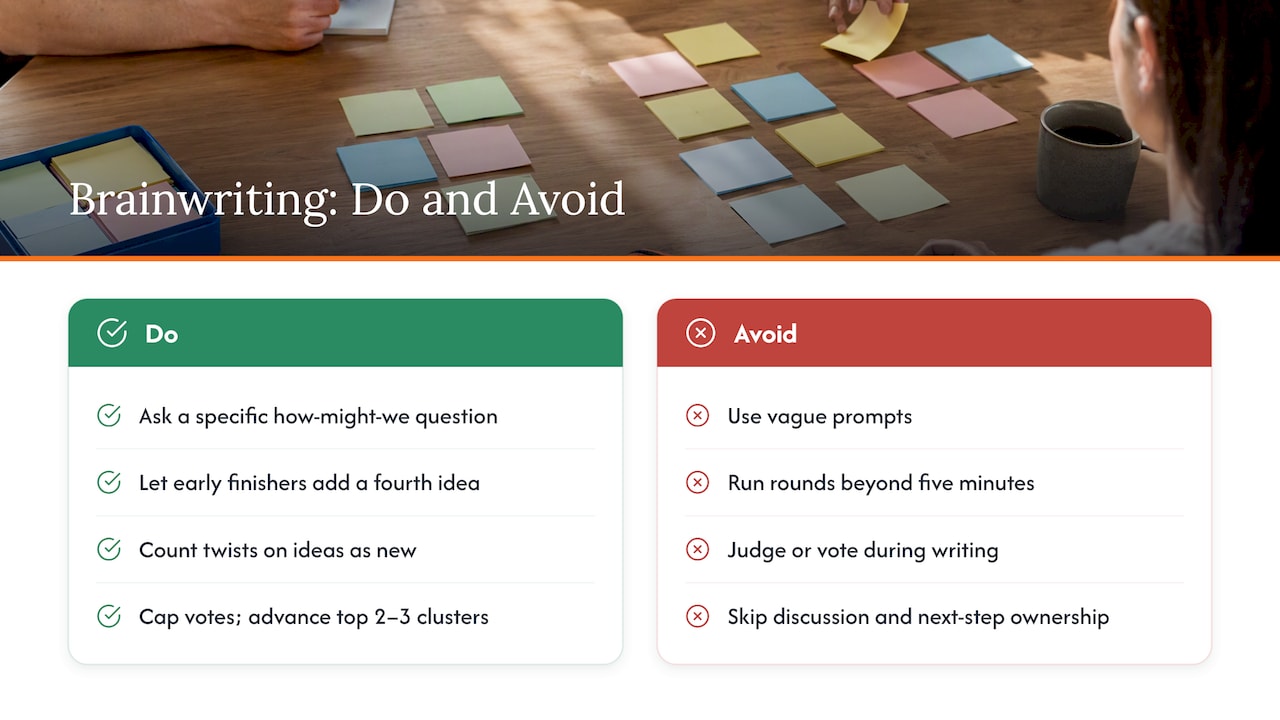
The prompt is too vague. “Marketing ideas” produces generic lists. “How might we reach first-year nursing students without paid ads?” produces usable ones.
Rounds are too long. Five minutes for three ideas is generous. Longer timers invite polishing, which slows the flow. If people finish early, let them add a fourth idea.
Nobody builds on anyone else. The point of rotating is cross-pollination. Remind participants that a twist on an existing idea counts as a new one.
Judging during the writing rounds. No emoji reactions, no comments, no voting until the clustering step. Evaluation belongs after generation.
Skipping the conversation. Brainwriting produces raw material. Without a closing discussion, the group never aligns on what the ideas mean or who owns the next step. This is the same synchronous alignment NN/G describes as hard to replace.
Too many ideas, no decision. A board with 100 notes feels productive and then stalls. Limit votes (three to five per person works well) and commit to taking only the top two or three clusters forward.
Other virtual idea generation techniques to pair with it
Brainwriting is one of several ways to generate ideas remotely. Combine it with these as needed:
- Silent brainstorming: a looser relative, in which people generate ideas individually and privately before sharing. Useful when you want less structure than 6-3-5.
- Mind mapping: good when you need to explore one theme in depth after clustering.
- Dot voting: the standard way to converge once the pile is big.
- Jigsaw and seminar formats: in classrooms, our guides to jigsaw activity facilitation and Socratic seminar facilitation show how to move from individual thinking to group discussion.
A useful pattern for a 60-minute workshop is 10 minutes for framing the prompt, 30 for brainwriting rounds, 10 for clustering and voting, and 10 for discussion and next steps.
FAQ
Is brainwriting better than brainstorming?
Not always, but it often produces more balanced input. Research summarized by Heslin points to dominance and production blocking as reasons verbal brainstorming underperforms, and brainwriting mitigates both. Use brainstorming for alignment and brainwriting for generating volume.
How many people do I need for brainwriting?
The 6-3-5 method is built for six, but it adapts easily. Groups of three to eight work, and larger groups can split into parallel boards of five or six. With very small groups, add a second pass so each person sees every list.
Can I run brainwriting online with students?
Yes. Give them a concrete prompt, a shorter timer, and a clear rotation direction. Students who rarely speak up in class often contribute more in writing, and you can review the board afterward to see who built on whose ideas.
Should brainwriting be anonymous?
It depends on the topic. Anonymity helps with sensitive subjects and with hierarchy, but it can make follow-up questions harder. Check how your tool handles names before you promise anonymity to participants.
Sources
- What is brainwriting? The 6-3-5 method explained, Zapier
- Group ideation with brainwriting: a comparison of co-located and distance collaboration, Design Society
- Better than brainstorming? Boundary conditions to brainwriting, Heslin
- Brainstorming Versus Brainwriting, Forbes
- The Diverge-and-Converge Technique for UX Workshops, NN/G
- Design and Evaluation of Eureka, a Digital 6-3-5 Brainwriting Tool
- A framework for remotely enabled co-design with young people, PMC
- What is Silent Brainstorming? Silent Focus